What 200 coaches taught a non coach about the future of the craft. EMCC Global Annual Conference 2026.
Three weeks before the event, I had not been invited. In February I sent a message to Erwin van 't Land, the newly appointed Chair of EMCC Global. He was in his first 100 days. I sent it anyway. Both Dutch, both more years outside the Netherlands than inside. That was enough.
Erwin introduced me to Araceli Canedo Bebbington at thought leadership, and to Ozlem Sarioglu at the Centre for Excellence on Digital and AI. A long conversation with all three. Then a deep dive with Ozlem. Then an invitation: would I co host the AI Lab with her in Zagreb on 11 to 13 May. I said yes before I had finished reading the message.
Three weeks from a cold message to a seat at one of the most thoughtful gatherings in professional coaching, as probably the only non coach co hosting a session. The contrast still tells me something.
Arriving as the non coach
I landed late on the Monday. By Tuesday morning I was in a room with 200 credentialled coaches from around the world. The theme of this year's conference was Beyond the Known: Ways of Being, Becoming and Leading. The kind of title you suspect was written by a committee and then meant by every speaker on stage.
This was the first conference where I felt the title earn itself by Friday.
The AI Lab
The AI Lab was on day two. Ninety minutes. Over 100 executive and leadership coaches. I asked at the start who was already using AI in their practice. Almost every hand went up. This is not the room from a year ago.
We worked through what AI actually does for an executive or leadership coach in 2026. Not theoretical mode. Hands on the prompts. By minute thirty the questions had moved from how do I use this for notes, to how do I shape this around my coachee. That is the shift, in one sentence. From AI as a tool, to AI as part of how you practise.
Somewhere in the middle I hit a groove I had not felt at an event in a long time. I forgot the room was on a clock at all. Co facilitating with Ozlem was the kind of work that feels like it just happens, when in fact she has done it a hundred times over and made the room safe enough for the rest to land.
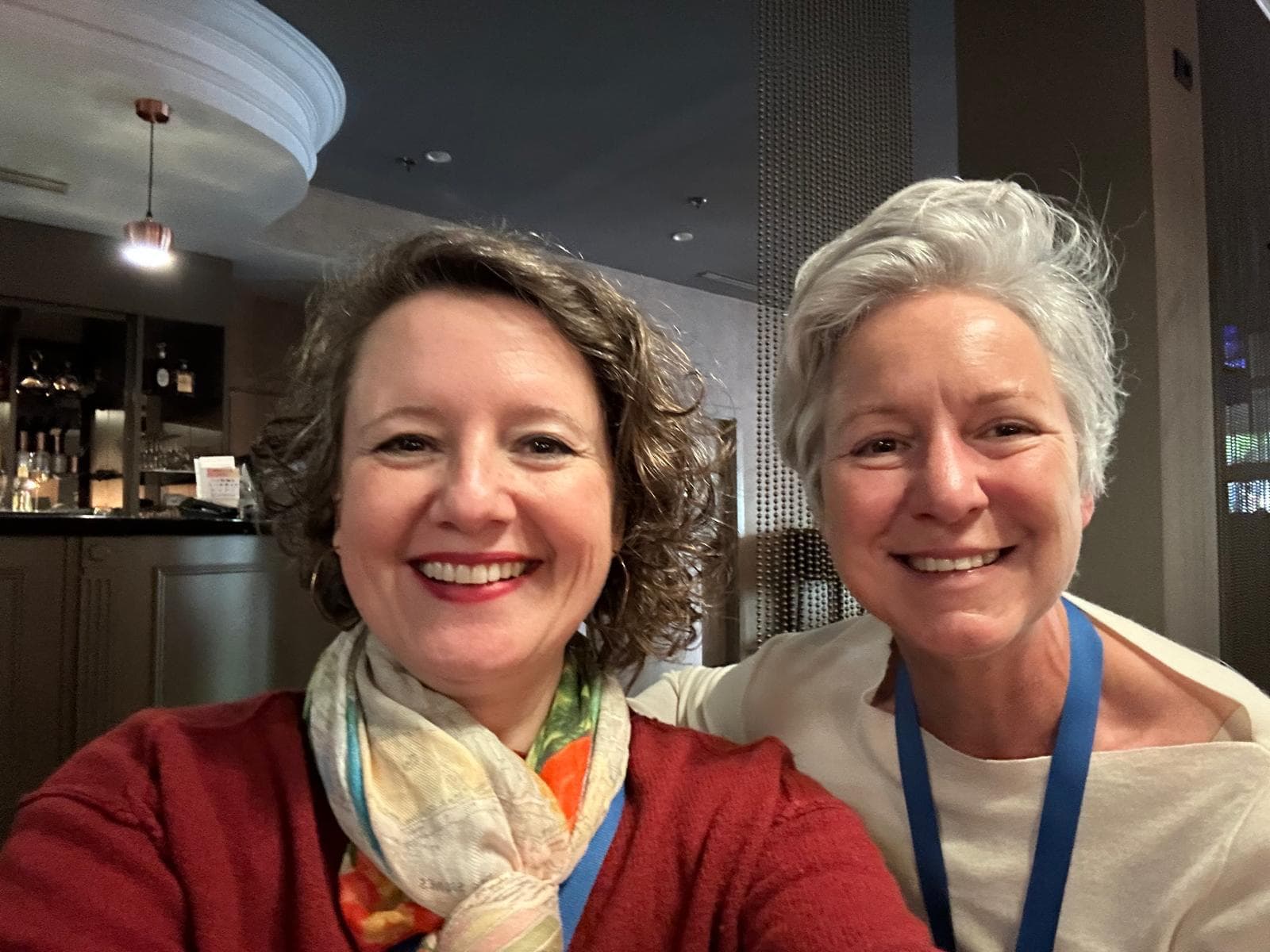
That was the mechanics. The deeper thing was the audience.
The keynotes that moved me
Three keynotes are still in my head a week later.
Prof Akihiko Morita, from the ICF Thought Leadership Institute, made a passionate plea about partnering with AI. Walk into the unknown anyway. The unknown is what makes the next ten years interesting.
Dr Lisa Lewis told us to stop assuming the older generation of coaches lacks the appetite. They do not. They carry wisdom the younger ones are reaching for. The intelligence in the room is intergenerational. The talent we bring into organisations should be human, technical and creative, together.
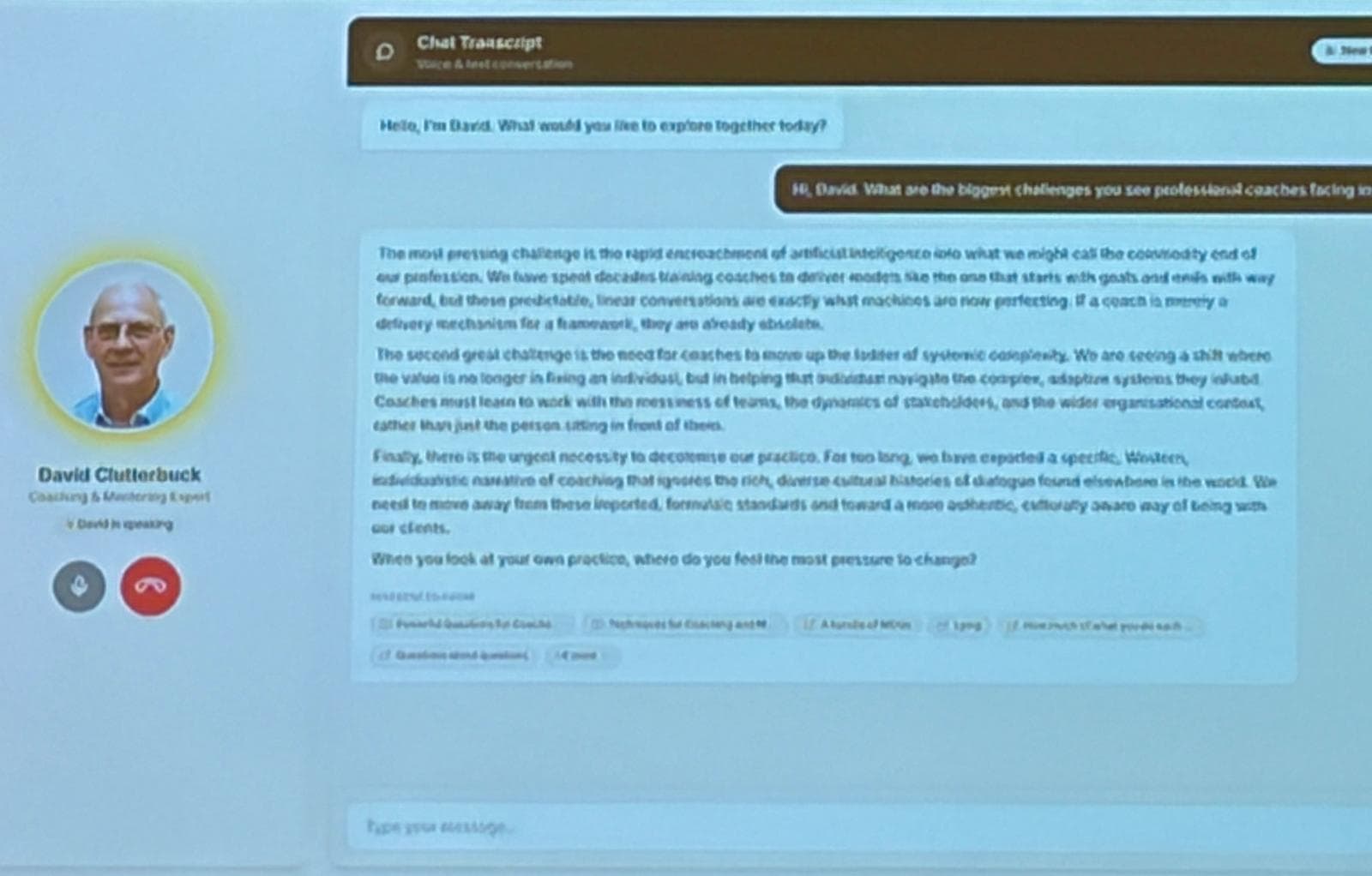
Prof David Clutterbuck unveiled his AI avatar live on stage, trained on his own books and in his own voice. A founder of the field in conversation with a version of himself that does not sleep. Trained on a life's work, by his own choice. Other founders of the field will face the same question. Whose voice, whose books, on whose terms.
As machine intelligence gets cheap, the experience of being human becomes the diamond.Said from the stage in Zagreb. I cannot place who said it. If you were in the room and remember, tell me.
Augmentation as the preferred way of being
The most consistent insight, gathered from keynotes and from dozens of smaller conversations, is that augmentation is becoming the preferred way of being for coaches. Not because AI replaces what mattered. Because it makes more room for what does. Presence. Attention. Dialogue. Sense making. The capacity to sit with ambiguity without rushing to collapse it.
Rainer von Leoprechting and Maha Alusi at People Spark AG captured this the day after the conference, in a post worth reading in full. Their thread: as AI takes over analysis, pattern recognition and knowledge access, our human value moves away from what we know and toward how we relate. And, in their words, AI not as just another productivity tool to make us faster, but as a relational infrastructure for human conversations and learning.
That is the direction some of us are building toward. Not replacing the coach with software. Extending the coach's reach with software the coach controls. The shift is not a future state. It is a present tense reorientation of where coaching can reach in a world where machine output is becoming a commodity.
The community
I have never been to a conference so open, so warm, so non commercial. People shared work that was clearly hard won as if they wanted others to use it. Conversations stayed substantive long after sessions ended. The conversation was still spilling onto LinkedIn a week later, which is its own kind of evidence.
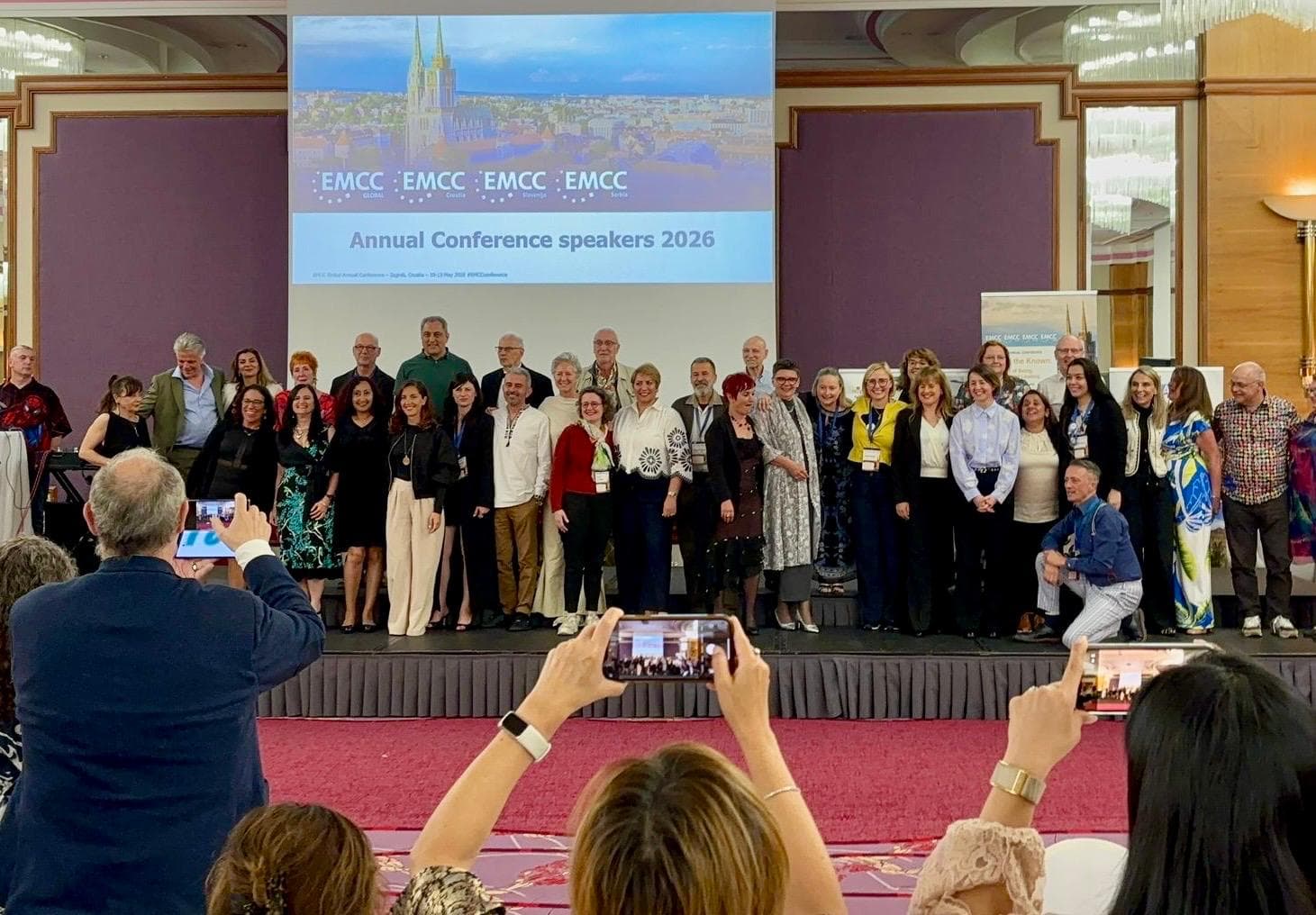
And then the Gala Dinner. The local EMCC chapters from Serbia, Croatia and Slovenia brought their cultures into the room with song, dance, and a coach conga line I will be replaying for weeks. Anyone who told you coaches do not know how to throw a party has not been to Zagreb.
The question I came home with
The question I left Zagreb turning over: when coach augmentation goes mainstream, which parts of the craft expand, and which parts must stay exactly as they are? Nobody in the room pretended to know. That was the best part. The room had the intellectual honesty to hold the question open.
What I am more sure of after Zagreb is that the people building the tools have to sit at the same tables as the people doing the work. EMCC made that obvious. So did the three days they gave me.
Thank you to Erwin, Araceli, Ozlem and the rest of the executive leadership team for the invitation, the trust and the seat. Thank you to Ozlem for the partnership in the Lab. And thank you to Rainer and Maha, who were unofficial guides into a world that is not mine.
Card at signup, first charge on day 61. Pause or cancel any client at any time.