The coach who gave up the top credential.
Jayne Warrilow held the ICF’s highest credential. Almost ten years ago, she chose to widen her practice beyond it. This issue, she’s our coach in the centre, and on 2 December she opens our last call of the year. And Laura Foltina, the privacy lawyer behind our data rules, shares the one question she asks every coach.
Big moments to share:
- 1Jayne Warrilow: why she gave up her MCC, and her workshop with us on Wed 2 December, where we are also discussing CoachNova for team coaching.
- 2Inviting a client: you now send the invitation yourself, and see exactly what your client gets.
- 3Laura Foltina: the privacy lawyer behind our data rules, and the one question she asks every coach.
Join us, and bring a coaching friend:
Save your seatCoaching beyond the competency list.

Jayne Warrilow became a Master Certified Coach, the ICF’s highest credential. Almost ten years ago, she left the ICF.
“I’m not against the ICF,” she told Louise last week. “I think they do great work, especially for new coaches.” But her coaching was moving beyond what a competency framework describes. In her words: “Competence is very different to capability.”
Since then, Jayne has written 11 books, built Sacred Changemakers into a community, a learning space and a podcast with 223 episodes. We started working with Jayne in July, and we talk regularly about where coaching and AI are going. Her Jayne AI is built from her own work.
Last week she turned the microphone on Louise for her podcast, Sacred Changemakers. Our conversation goes live next week, on Tuesday 1 December. The working title: Can AI make coaching more human? Jayne sees AI as “illuminating what coaching is”. And her advice to every coach still deciding:
“Go and try it out for yourself first so that you can make an informed decision about where your boundaries are.”
She has done exactly that. She’s piloting her own AI policy for her practice.
Part one: what’s coming for you in 2027? Jayne sees coaches needing a place to come together and go deeper on what AI means for our work, and we’re exploring how we can create that space together. A first step is this interactive workshop. Jayne opens with the question, then we work on it together in small groups.
Part two: how do you coach a team? Many of you already coach teams as well as individuals. Founders and leadership teams are asking us how CoachNova could support the whole team, with one coach. It’s on our roadmap for early 2027, and before we build anything, we want your input. When you coach a team rather than one person, what should CoachNova do for you?
We’d love to meet your coaching friends too. Bring them along. It’s the season to give and connect.
See it exactly as your client will.
Coaches asked us for this: before a client sees CoachNova, you want to see it yourself. So now you send the invitation yourself, from your dashboard, and you see it exactly as your client gets it before it goes.
When you open your Coach AI to a client, they get a second email: “Meet [Your name] AI.” Your name, your way of working, in their pocket.
Want to try the whole experience first? Every account has a demo client called Alex. Copy the address on Alex’s profile and sign in with it in the CoachNova app on your phone. The login code comes to your own inbox. Find Alex in your client list →
Or watch Nick show you, in 74 seconds. What your client sees →
What we take from it: send it on a day you’ve just spoken. An invitation that lands right after a good session is more likely to get opened.
Meet Laura Foltina.
Privacy that fits the way you coach.
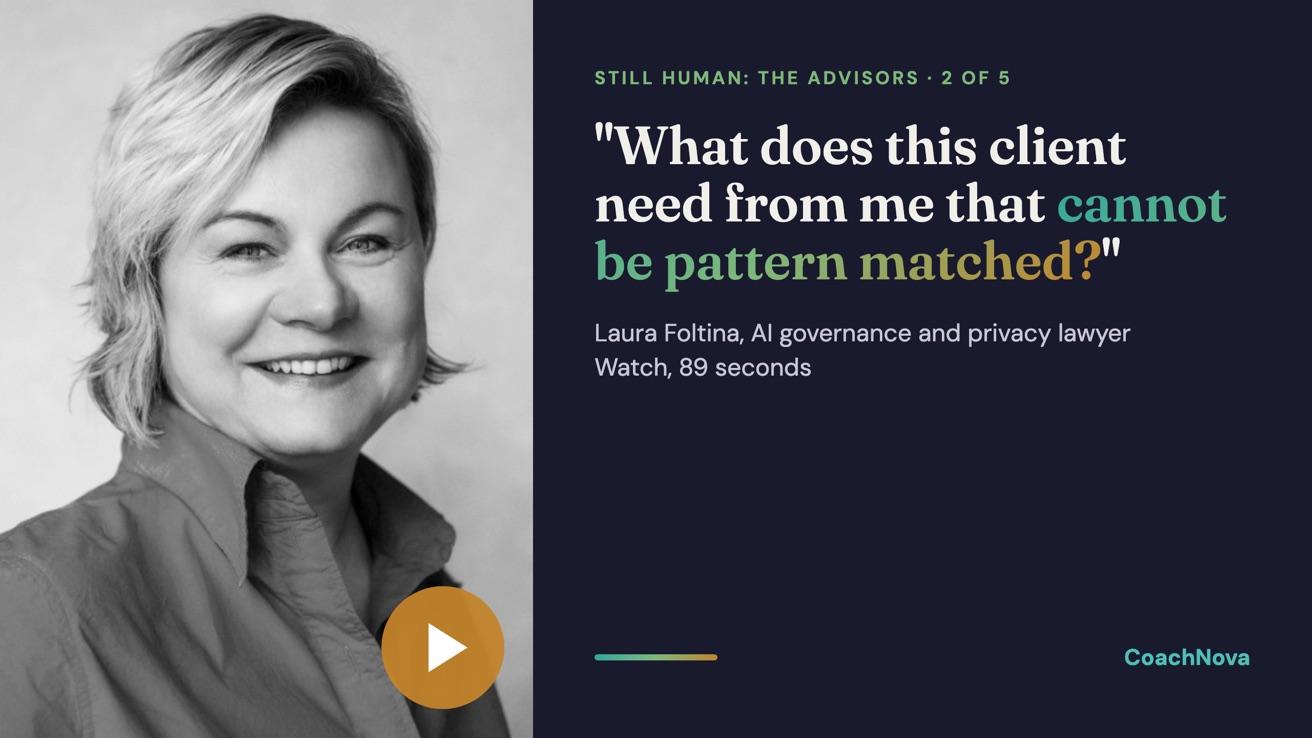
It takes a village to raise a startup. This issue, meet Laura Foltina in Amsterdam.
Laura is an AI governance and privacy lawyer on our advisory board. She spent twenty years as senior in-house counsel at listed technology and life sciences companies, then founded FideAI, which advises companies on AI governance and privacy. Our Terms, Data Processing Agreement and Privacy Policy were written with her.
A team coach we both know introduced us. In her first message, Laura said she wanted to help shape responsible AI use in coaching.
Governance as a design input
For Laura, governance comes before the code. What data do we need, and why? Who can see it? What happens when a client needs a human? Her rule: “Start small. You can always expand later.”
Those questions shaped Coach AI, which supports your clients between and beyond sessions:
- The coach sees every conversation.
- Clients know they are talking to AI.
- If a client may be in crisis, the AI points them to real help.
- The coach owns their content and what the AI produces from it.
“Laura raised the sharp questions early and helped us make the choices that shaped the product.”
Nick Ponomar, CTO
Her question for coaches:
“What does this client need from me that cannot be pattern matched?”
AI carries the patterns. You bring the presence, the accountability, and what is not being said.
Laura has written up the five questions she asked us, with what each one means for your own practice:
What to ask before a client talks to AI, who owns what it produces, and what to put in your client agreement. 7 minute read.
Read Laura’s articleMore from Laura at fideai.eu.
Talk soon,
Louise and Nick
Co-founders, CoachNova
PS. Know a coach who should see this? Forward it. That’s how this community grows.
Get the next issue
Every two weeks. Five minutes. Worth opening.